 Home
Home
Video Inspections
Sewer and Drain Video Camera Inspection
in Rhode Island and Massachusetts
Most sewer and drain problems are invisible until they've already caused damage. A pipe can be cracking, filling with roots, or slowly collapsing underground for years without a single symptom above the surface — until suddenly it backs up, floods a basement, or fails entirely. By that point, what could have been a straightforward repair has become an emergency, and the costs are far higher.
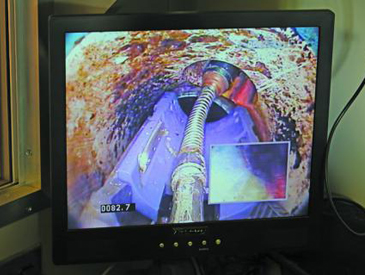
A video camera inspection changes that. Instead of guessing at what's happening beneath your yard or behind your walls, we send a high-definition waterproof camera directly into your drain or sewer line and show you the interior of your pipes in real time — exactly as they are, exactly where the problem is.
At Wood's Rooter, we use camera inspection as both a standalone diagnostic service and as the mandatory first step before any water jetting or pipe lining work. We've been running cameras through drains and sewer lines across Rhode Island and Southern Massachusetts since 2007, and in our experience, it is the single most important tool in getting a drain or sewer problem fixed correctly the first time.
Video Inspection FAQs
No, however, this surprises many homebuyers. A standard home inspection covers visible and accessible systems: the roof, foundation, interior structure, electrical panel, HVAC, and visible plumbing fixtures. It does not include a camera inspection of the underground sewer lateral, which is the pipe that connects your home's plumbing to the city sewer or a septic system. That pipe can be completely out of sight and out of mind during a home inspection while quietly harboring root intrusion, cracks, or a partial collapse underground. A sewer scope inspection must be scheduled separately and is strongly recommended for any home older than 20 years.
Woods Rooter give quotes over the phone before we schedule anything, so there are no surprises when we arrive. What we can tell you is that the cost of a professional camera inspection is a fraction of what most sewer repairs cost are a very small fraction of what a full sewer line replacement costs. For homebuyers especially, the inspection is one of the highest-return investments you can make before closing. Call us at (401) 432-6405 (RI) or (508) 377-4737 (MA) and we'll give you a straight number.
For most residential sewer lines, the inspection itself from camera insertion to review of findings, this can take 30 to 60 minutes. Longer lines, complex layouts, or commercial properties may take more time. We'll give you a realistic time estimate when you call, and we schedule with enough time to do the job properly rather than rushing through it
The camera captures the full interior of your pipe in real time — everything visible from the camera's perspective as it moves through the line. That includes the condition of the pipe walls (corrosion, scaling, cracks, holes), the pipe joints (offsets, separations, root entry points), any blockages or buildup present (root masses, grease accumulation, foreign objects), structural issues like a pipe belly (low spot where water pools), and the overall grade and alignment of the line. It also gives us a clear indication of the pipe material, which is important for choosing the right repair or cleaning approach.
We'll show you the footage, explain clearly what we found and what it means, and walk you through your realistic options along with honest cost ranges. You're never pressured to make a decision on the spot. We give you the information and let you decide. If the problem is urgent — a complete blockage or a section near collapse — we'll tell you that directly. If it's something that can be monitored or addressed on a timeline, we'll tell you that too.
Yes — many buyers do exactly this. If our camera inspection reveals a significant issue with the sewer line, you have documented evidence of the problem that can be used to request a price reduction, ask the seller to repair the issue before closing, or negotiate a credit that covers the estimated repair cost. Real estate attorneys and agents across Rhode Island and Massachusetts commonly advise buyers to request sewer scopes during the inspection period specifically because of this leverage. We can schedule quickly to fit within your contingency window — just call and tell us your timeline.
Ask us when you call — we're happy to discuss what we can provide in terms of documentation. What we can guarantee is that you'll see the footage in real time, on screen, as the inspection is happening. Our technician will narrate what the camera is showing and explain any findings before the job is done. You won't be left wondering what was found or told after the fact.
Yes — for a residential inspection, a household member or authorized person should be present to provide access and to see the findings firsthand. The inspection is most valuable when you're there to watch the footage and ask questions as the camera moves through the line. For commercial properties with on-site management, arrangements can sometimes be made in advance.
Our camera equipment typically reaches 75 to 100 feet into a line — far enough to cover most residential sewer laterals from the house connection to the main sewer. For longer runs or commercial applications, we'll discuss the scope of the inspection when you call and make sure we're using the right equipment for the job.
It's not a problem yet — but it's a reason to get one done. Homes built in the 1950s, 60s, and 70s typically have clay or cast iron sewer pipes that are now 50 to 70 years old. Those materials have a finite lifespan, and they're particularly vulnerable to root intrusion at the joints, cracking from ground movement and freeze-thaw cycles, and scale buildup that progressively narrows the pipe. The fact that things seem to be draining fine today doesn't mean the pipe is in good shape — it often means the problem just hasn't reached a critical point yet. A camera inspection tells you where you actually stand.
Yes, they refer to the same service. "Sewer scope," "video camera inspection," "pipe camera inspection," and "CCTV drain inspection" are all terms used for the same process of inserting a camera-equipped cable into a drain or sewer line to inspect its interior. Different companies and regions use different names for the same technology.
Not necessarily — but if the clog has come back multiple times, or if the technician who did the snaking mentioned concerns about what they felt in the pipe, it's worth knowing more. Snaking can clear a blockage without identifying the underlying cause. If there are roots in the pipe, a developing crack, or heavy wall buildup, snaking provides temporary relief without addressing what's actually happening. A camera confirms whether the pipe is genuinely clear and healthy or just temporarily open.
Yes — a pipe belly (also called negative grade) is clearly visible on camera as a section of pipe where the floor of the pipe sits lower than the surrounding sections, creating a visible low point where water and solids pool. It appears on screen as standing water in a section of otherwise clear pipe. A belly is a structural issue caused by ground settling, and it typically can't be resolved by cleaning alone. The camera tells us exactly where it is and how pronounced it is, which informs the repair options.
Absolutely. Homebuyers are one of the most common audiences for camera inspection, but they're far from the only one. If you've had recurring drain problems, if your home is more than 20 years old and has never had the sewer line inspected, if you have mature trees on or near your property, if you're planning a renovation or addition, or if you simply want to know the condition of a system you depend on every day — a camera inspection gives you real information instead of assumptions. The peace of mind alone, and the ability to address small issues before they become expensive emergencies, makes it worthwhile for most homeowners.
What to Expect and How Video Inspection Works

Step 1: Find the Access Point
We identify the best entry point for the camera — a cleanout port, a drain opening, or a toilet — based on your specific pipe layout and what we're trying to inspect. We explain what we're doing and why before anything goes into the pipe.

Step 2: The Camera runs through the line
A flexible push rod tipped with a high-definition, waterproof camera is fed into the pipe. Built-in LED lights illuminate the interior clearly, and the camera transmits a live video feed to an above-ground monitor. The camera can navigate bends and transitions and typically reaches 75 to 100 feet into the line.

Step 3: Review Our Findings
You watch what we see, on screen, as the camera moves through the pipe. Our technician narrates what's visible — identifying problem areas, explaining what caused them, and answering questions as they come up. There are no hidden findings reported later. What the camera shows, you see.