 Home
Home
Sewer Line Location Service in RI
Private Sewer and Drain Line Location Services in Rhode Island and Massachusetts
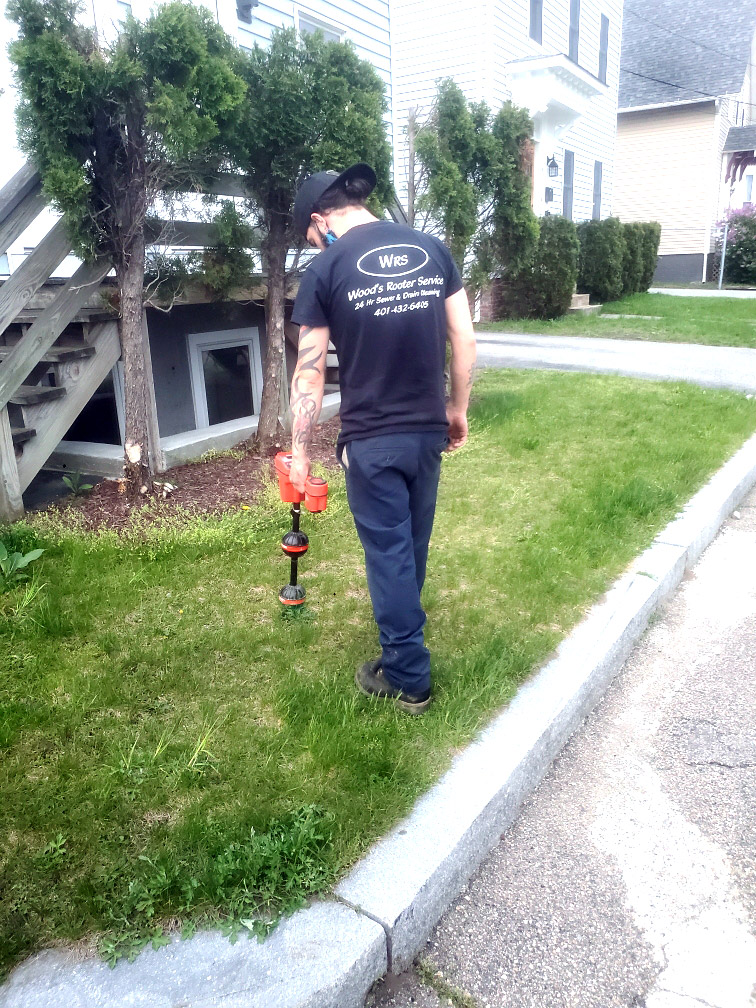
Most people know roughly where their sewer line runs. Fewer know its exact depth, precise path across the property, or where it connects to tie-ins along the way. And almost nobody knows the exact location of their buried cleanout, the depth at which the line passes under the driveway, or how the original pipe routing in an older home compares to where the landscapers are about to start digging.
That gap between what homeowners and contractors think they know and what is actually underneath the ground is where damaged pipes, blown project budgets, and expensive emergency calls come from.
Wood's Rooter's line location service closes that gap. Using a professional sonde transmitter mounted at the head of our sewer camera, we can pinpoint the exact location and depth of any accessible private sewer or drain line, trace its route from one end to the other, identify tie-ins and direction changes along the way, and mark the surface above the pipe so anyone working on the property knows exactly what is below them and how deep it is.
We have been providing line location services to homeowners, contractors, and commercial clients across Rhode Island and Southern Massachusetts since 2007. It is a service most people have never requested before the first time they need it, and it is one of the most useful and straightforward services we offer.
Sewer Line Location FAQs
No, and this is one of the most important things for homeowners and contractors to understand. Calling 811 (Dig Safe) before excavation is required by law in Rhode Island and Massachusetts, and it marks public utilities up to the meter or property line: gas mains, public water lines, electrical distribution lines, and telecommunications infrastructure maintained by utility companies.
Your private sewer lateral (the pipe connecting your home to the municipal sewer), your private drain lines, and all septic system components are private utilities.
They are not covered by 811, and locating them before any excavation is entirely your responsibility as the property owner. Wood's Rooter locates exactly these private lines, filling the gap that 811 leaves.
A sonde is a small electronic transmitter that mounts at the head of our sewer camera. As the camera moves through your pipe, the sonde emits a continuous electromagnetic signal at 512 Hz. That signal travels through the pipe wall and upward through the surrounding soil, concrete, or asphalt.
Our above-ground receiver picks up the signal and tracks the camera's position in real time. By following the signal path across the surface, we can mark the pipe's exact horizontal position at any point along its route.
The signal strength also allows the receiver to calculate the depth of the sonde below the surface, giving us accurate depth readings at each marked location. The result is a surface-marked map of where your pipe runs and how deep it is at each point along the route.
Yes, we can locate any pipe material, including PVC, clay, concrete, Orangeburg, and cast iron. External electromagnetic pipe locators rely on the pipe itself conducting an electrical signal, which limits them to metallic pipes.
Our sonde-based method is different: the transmitter is inside the pipe and produces its own signal regardless of what the pipe is made of. As long as we can access the line with our camera to insert the sonde, we can locate it. This makes sonde-based location particularly useful for older New England properties, which often have clay or Orangeburg sewer laterals that external locators cannot find.
Under normal soil conditions, our sonde equipment provides depth readings accurate to within a few inches. The accuracy can be affected by factors such as very deep pipes (over 15 feet), highly mineralized soil, nearby metal structures, or strong electromagnetic interference in the area.
In the vast majority of residential and commercial applications we encounter in Rhode Island and Massachusetts, the depth readings are precise enough for safe excavation planning. We will tell you if site conditions appear to affect the accuracy of the readings.
Yes. Finding buried or lost cleanouts is one of the most common reasons homeowners in Rhode Island and Massachusetts call us for line location. Cleanouts in older homes are frequently covered by decades of landscaping changes, lawn resodding, driveway repaving, or settled soil.
We locate the sewer line using our sonde camera and can identify the cleanout's position along the line. Once located, we mark the surface above it so the cleanout cap can be excavated and restored to accessible depth for future service. In many cases, once the cleanout is located and cleared, we can proceed directly with drain snaking, jetting, or a camera inspection in the same visit.
In many cases, yes. We can trace the sewer line from the house connection to the septic tank, which in most cases allows us to identify the tank's location and approximate depth.
From there, we may also be able to help identify the distribution box location depending on the system layout. Precise leach field mapping is more complex and depends on the specific system configuration. When you call, describe what you are trying to locate and we will tell you what our equipment can reliably identify for your type of system.
We mark the pipe's route on the surface with flags or spray paint at regular intervals and at every direction change or tie-in point along the line. We record and can provide depth measurements at each marked point.
Before we leave, we walk the marked route with you to confirm the results and explain anything unexpected we found during the trace. The surface markings and depth data give your excavation crew a clear, accurate picture of what is below the ground before any digging begins.
For a typical residential sewer lateral, locating and marking the pipe from the house to the main or septic connection takes between 45 minutes and 90 minutes, depending on the length of the line, the number of direction changes, and site access conditions.
A full end-to-end trace with multiple tie-ins or a complex routing may take longer. We will give you a realistic time estimate when you call and describe the scope of what you need located.
Yes, and we work with contractors across Rhode Island and Massachusetts regularly. We understand that project timelines move quickly and that a line location visit needs to fit the schedule.
We can work directly with your crew, schedule around project timelines, and provide the surface markings and depth data your team needs before equipment goes in the ground.
If you manage multiple job sites and need private line location as a standard part of your pre-dig process, contact us to discuss a standing service relationship. Having a reliable private utility locator in your network protects your crew, your clients, and your project budgets.
In most cases, yes. Because we are already running the camera through the pipe to operate the sonde, adding a camera inspection to the same visit is straightforward. You get both location data and interior condition data from a single mobilization, which is more efficient and cost-effective than scheduling two separate visits. If you need both services, mention it when you call and we will confirm whether a combined visit makes sense for your specific situation.
Yes, as long as we can access each line separately with our camera. Locating multiple lines on a property requires separate camera insertions for each line, which adds to the visit time. Describe your property's drain configuration when you call and we will advise on how to approach the location efficiently.
It is worth considering, even for shallow post holes. Private sewer laterals in older Rhode Island and Massachusetts homes can run at surprisingly shallow depths, particularly in areas where the soil has settled or the grade has been modified over the years.
A fence post struck through a clay sewer lateral means a repair that far exceeds the cost of a line location visit. Whether it is necessary depends on how confident you are about where your line runs and how much the repair would cost if a post hit it. If there is any uncertainty, the location visit is cheaper than the alternative.
We tell you about it clearly before we leave. Unexpected findings during a trace might include a shallower-than-expected pipe depth at a particular point, an unanticipated direction change or tie-in, evidence of a previous repair or pipe replacement, or a routing that differs from what the homeowner or contractor expected.
None of this changes what we were asked to do, but it is information you need to have before excavation begins. If the finding suggests a more significant issue (a pipe that appears to have shifted or a routing that could create a problem for the planned project), we will explain what we saw and what we recommend as a next step.
What to expect when you call us for line location

Accurate results, explained clearly.
We don't hand you a set of flags and leave. At the end of every line location visit, we walk the marked route with you, explain what we found, confirm the depth readings at key points, and answer any questions. You leave knowing exactly what is below your property and what it means for your project.

Equipment that works on any pipe material.
Because we use sonde-based location rather than external electromagnetic equipment, we can locate any pipe material, including the clay, cast iron, and Orangeburg pipes common in older Rhode Island and Massachusetts properties. If we can access the line with our camera, we can locate it.

Honest assessment of what we find.
If we find something unexpected during a trace, we tell you about it clearly. An unanticipated direction change, a shallower depth than expected at a critical point, or evidence of a previous repair are all things you need to know. We don't withhold information to keep the job simple.